| The Institute of Human Virology, Nigeria (IHVN) is seeking bidders to bid for the Supply of Laboratory Items under ASPIRE grant. | |
| Opening Date/ Time: | 07/05/2024 8:00 am |
| Closing Date/ Time: | 27/05/2024 10:00 am |
| For more on this bid, Please download the complete bid document and BOQ here; | |
Bid Advert – Supply of Diesel (AGO) under ASPIRE grant
| The Institute of Human Virology, Nigeria (IHVN) is seeking bidders to bid for the Supply of Diesel (AGO) under ASPIRE grant. | |
| Opening Date/ Time: | 06/05/2024 8:00 am |
| Closing Date/ Time: | 17/05/2024 10:00 am |
| For more on this bid, Please download the complete bid document and BOQ here; | |
Bid Advert – Auction of Unserviceable Office Items
Invitation to Bid for the Auction of Unserviceable Office Items
The Institute of Human Virology (IHVN) is a leading and reputable non-governmental organization addressing infectious and non-infectious diseases such as HIV, tuberculosis, and cancer through the provision of prevention, diagnosis, treatment, capacity building, research, and care and support services. IHVN is in partnership with local and international organizations and the different tiers of the government of Nigeria at national, state, and local levels. The Institute’s vision is to be a leader in providing quality health services, capacity building and research in West Africa and beyond.
IHVN is calling for participation in an auction of unserviceable items.
- Link to List of Electronic/Sensitive Items
- Link to List of Accountable Items
- Link to List of Laboratory Equipment
- Link to List of Vehicles
GENERAL REQUIREMENT
Aside from the standard procurement requirements, please find below the conditions of the disposal,
- Items on disposal are bought “as they are” without any liability to the Institute.
- Sealed bids are to be submitted to the Procurement Unit specifying the quantity, type, and price of items bided for.
- The bid envelope should be boldly marked “unserviceable items”.
- The bid period is for ten (10) working days (April 23rd to 7th May 2024).
- At the expiration of the bid period, all bids will be opened by a representative of the procurement department with representatives of Finance & Administration and compliance departments in attendance.
- The highest bidder wins the bid, but IHVN staff shall be accorded priority on bids if his/her bid tallies with that of an outsider, and winners will be communicated by the admin unit.
- Bid winners are to make payment within 48 hours to the designated account, failure which the item(s) shall be offered to the next highest bidder, and so forth.
- All items are based on locations indicated against the asset.
- A bid report will be submitted to the Centers for Disease Control and Prevention (CDC) and IHVN Executive Management through the Director of Finance and Administration after the completion of the bid exercise.
SUBMISSION OF BIDS
Interested persons should submit their bids in sealed envelope boldly marked at the top left.
corner: –
“BID FOR AUCTION OF UNSERVICEABLE ITEM(S)’’
and addressed to: –
Deputy Director SCM/Procurement
Institute of Human Virology, Nigeria
IHVN Campus, 6th Floor, Cadastral Zone COO
Plot 62, after BAZE University, Off CITEC Road, Abuja-NIGERIA.
Tel: +234 (0) 9 4610342.
Bid Advert – Supply of Laboratory Items under the GF N-THRIP Grant
| The Institute of Human Virology, Nigeria (IHVN) is seeking bidders to bid for the Supply of Laboratory Items under the GF N-THRIP Grant. | |
| Opening Date/ Time: | 23/04/2024 8:00 am |
| Closing Date/ Time: | 13/05/2024 10:00 am |
| For more on this bid, Please download the complete bid document and BOQ here; | |
IHVN Trains Health Workers on Cervical Cancer Prevention
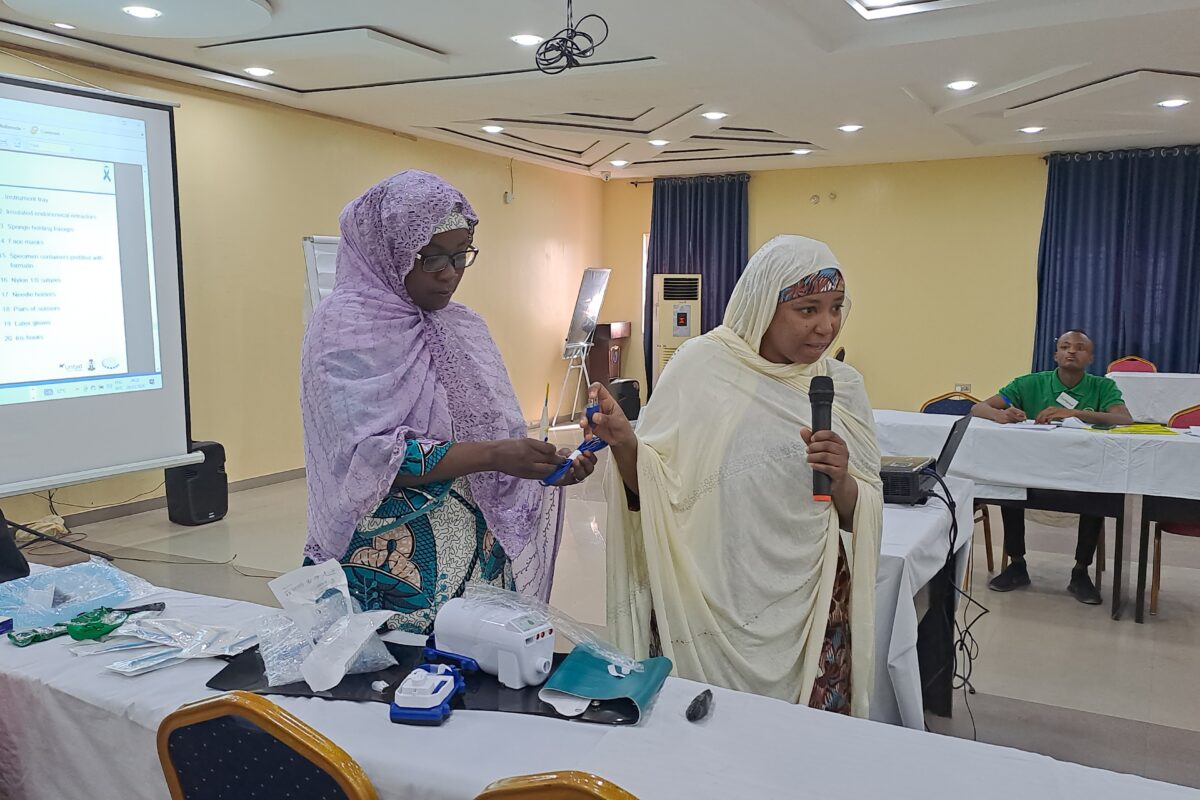
To equip healthcare workers with the knowledge and skills for prevention and management of cervical pre-cancerous lesions, the Institute of Human Virology Nigeria (IHVN) has trained 63 health workers in the FCT, Katsina, Nasarawa, and Rivers States.
During the three-day training, participants engaged in practical demonstrations on the use of Loop Electrosurgical Excision Procedure (LEEP) machine in managing pre-cancerous cervical lesions. Trainees, including doctors and nurses, built their capacity on cervical cancer treatment methods and screening in a see-and-treat program, infection prevention, as well as sterilization. They are to step down the training to others in their health facilities for improved screening and treatment of precancerous lesions among Women Living with HIV (WLHIV)
IHVN Program Manager, Dr. Victoria Igbinomwanhia said that the training is important in building the capacity of health care workers in facilities supported by IHVN across all four States in the screening and treatment of WLHIV.
“Women Living with HIV are six times more predisposed to cervical cancer compared to non-WLHIV. The training provided these professionals with the required skills to identify precancerous lesions and promptly treat using either the thermo-ablation or LEEP machine depending on the location and extent of the lesion. This ensures that eligible WLHIV between the ages of 25 and 49 years who receive care and treatment at the ART clinics are provided screening yearly. This Is a component of the HIV comprehensive care package to improve the quality of life and reduce mortality in already stable WLHIV,” she said.
According to Dr. Igbinomwanhia, the next steps following the training include distribution of LEEP machines to all four States, step-down training to other facility staff championed by the trained participants, continued onsite mentoring and supervision and immediate treatment of all clients identified with precancerous lesions amenable for treatment with the LEEP machine.
Dr. Oluseyi Asaolu, who participated in the FCT training, said that the training was beneficial and looks forward to stepping it down to resident doctors “The most important thing is scaling it down to others who can use the equipment regardless of who is on duty.” Another participant, Mrs. Aisha Haladu from Kastina State, said that utilizing the LEEP machine would benefit clients who would ordinarily be unable to afford cervical cancer screening.